 Skip to content


Ayurveda is India's heritage. A gift to the world. In this day and age when everyone is turning away from the harsh medical substances that have more side effects than real good effects. And that is slowly turning everybody to our roots, our heritage, Ayurveda. Now you might be asking yourself how Ayurveda can help in hair growth. There are many medical researches that have shown how ayurveda actually targets the root cause for hair problem instead of the hair loss itself. This gives a more holistic approach to the problem. Using this philosophy Traya has bought a resurgence in ayurvedic hair solutions. But people are still confused if Traya’s ayurvedic products are pure or a hybrid kind.
In this blog we will discuss the ayurveda angle of our holistic approach to hair care.
Traya’s Ayurvedic Foundation
Core Ayurvedic principles used: Pitta balance, DHT control, Agni (digestion)
-
Ashwagandha in Calm Ras
Ashwagandha, also known as Withania somnifera, or “Indian ginseng”, is a powerful herb used extensively in Ayurvedic medicine for over 3,000 years. It helps the body manage stress.

What does Ashwagandha used in Calm Ras help with?
An important cause of hair fall is disturbed sleep and stress which impact on our hair health. During sleep, our body goes through essential repair processes that are heavily affected by sleep deprivation. This weakens our hair structure and increases hair fall.
Calm Ras helps to relieve stress, improve sleep quality and supports mental health.
It helps to:
-
Reduce mental fatigue
-
De-stress naturally
-
Improve sleep cycle
-
Nourishes the nervous system helping create a barrier against stress.
It targets some of the most common causes of hairfall such as stress, anxiety, mental fatigue and sleep disturbances.
-
Bhringraj in Hair Ras.
Bhringraj, also known as Eclipta alba, or the "King of Hair," is a revered herb in Ayurvedic medicine traditionally used to promote hair growth, support liver health, and rejuvenate the body.

What does Bhringraj used in Hair Ras help with?
Inadequate sleep, diet and lifestyle can cause an imbalance of Pitta dosha and hormones. It also affects hair follicle health and blood flow to the scalp which leads to hairfall.
Hair Ras helps to balance pitta dosha and works on maintaining scalp and hair health with the help of adaptogenic herbs. It increases blood flow to hair follicles to nourish them from within and also helps in tissue nourishment of the Asthi Dhatu.
It helps to:
-
Balances pitta dosha and works directly on hair fall
-
Improves blood circulation to the hair follicles
-
Equivalent to Chavanprash for the hair
-
Improves hair quality
-
May delay early greying
Read more about Bhringraj here.
-
Yashtimadhu in Nasal Grit.
Yashtimadhu also known as Glycyrrhiza glabra, or the “licorice root", is a cherished herb in Ayurvedic medicine traditionally used to soothe the digestive tract, support respiratory health, and balance the body's inflammatory response.

What does Yashtimadhu in Nasal grit help with?
According to Ayurvedic texts, the nasal passage is the gateway to the head, including the brain, hair, eyes, and ears (Nasa hi shirso dwaram). This gateway allows for the administration of medication and nourishment through substances applied to the nostrils.
Traya Nasal Ghrit targets the root causes of hair fall and thinning, addressing issues like poor sleep patterns and physical and mental stress. This Ayurvedic product features pure ghee medicated with potent herbs, helping to alleviate stress, enhance sleep, and nourish hair follicles, resulting in healthier hair and reduced hair loss.
Nasal drops are effective because of the special properties of Shatavari and Yashtimadhu. These properties help to improve hair health.
It also helps with:
-
Work on hair growth
-
Aids in restful sleep
-
Induces calm by reducing stress
-
Relief from headaches.
-
Shatavari in Her Santulan
Shatavari (Asparagus racemosus), also known as the "queen of herbs" in Ayurveda, is traditionally used to support female reproductive health, enhance hormonal balance, and nourish the body during all stages of life.

What does Shatavari in Her Santulan help with?
Women after the age of 30 years go through diverse changes within her body, which requires attention and additional care. There may be symptoms like mood swings, irritability, irregular cycles, low estrogen levels, etc.
Her Santulan aims at calming these symptoms that affect female reproductive health, hormone levels and mental health.
It also helps in:
-
Helps to reduce hormonal triggered hairfall in women
-
Supports Female Reproductive Health and nourishment needs of a female
-
Mental Well-being
-
Anti-Inflammatory Support
-
Helps to Balance Hormones
-
Recommended for women >= 35 years of age as the nourishment needs change in the body.
-
Brahmi in Hair ras 1
Brahmi (Bacopa monnieri), a revered herb in Ayurvedic medicine, is traditionally used to enhance cognitive function, improve memory and concentration, and promote mental clarity and emotional calm.

What does Brahmi in Hair Ras 1 help with?
Hair Ras 01 is a holistic Ayurvedic formulation designed to address multiple wellness concerns, including hair fall, stress, energy levels, constipation, and digestive discomforts such as gas. This carefully crafted blend draws on centuries-old Ayurvedic wisdom to support overall well-being by targeting the root causes of these issues. Hair Ras 01 works harmoniously with the body's natural processes to restore balance, promoting a healthy scalp and hair, enhancing vitality, and improving digestive health.
For hair fall, it strengthens the hair roots and revitalizes the scalp, promoting healthy hair growth and reducing breakage. The formulation helps alleviate stress by calming the mind and supporting mental clarity, which in turn reduces the impact of stress on the body, including hair loss. For those experiencing low energy levels, Hair Ras 01 enhances vitality and endurance, combating fatigue and boosting overall energy. It also addresses digestive issues by improving gut health, alleviating constipation, and reducing bloating and gas, thus ensuring that your digestive system functions optimally.
-
Amla in Gutt Shudhi?
Amla (Emblica officinalis), also known as Indian gooseberry, is a potent rejuvenating herb in Ayurvedic medicine traditionally used to boost immunity, support healthy digestion, and promote strong hair and glowing skin.
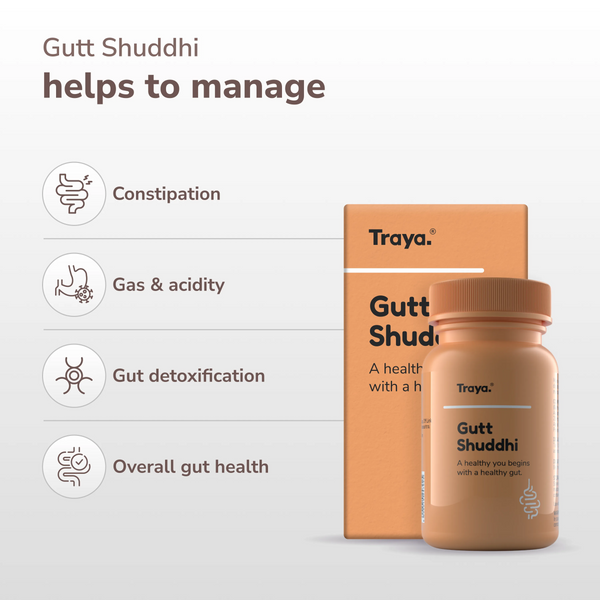
What does Amla in Gutt Shudhi help with?
It targets the root causes of hair loss and thinning, such as poor digestion, incomplete bowel movements, low gut motility, and the buildup of toxins in the body.
This tablet acts as a detoxifying agent for the gut and helps to promote the growth of good gut bacteria thus improving hair health. These non-laxative herbal tablets support gut health and aids to provide relief from gut problems such as gas, constipation, and acidity.
How is the gut related to hair loss?
Poor digestion directly affects the activity of our gut microbiome, limiting nutrient absorption leading to hair fall. Take a 2 Min FREE GUT HEALTH TEST with Mool Health, to quickly identify your Gut Health.
-
Triphala in Consti Clear
Triphala, a classical Ayurvedic formulation made from Amla (Emblica officinalis), Haritaki (Terminalia chebula), and Bibhitaki (Terminalia bellirica), is traditionally used to support digestive health, promote gentle detoxification, and balance all three doshas for overall well-being.

What does Triphala in Consti Clear help with?
Gut Health plays a significant role in maintaining healthy hair. Issues such as constipation, gastrointestinal discomfort, poor digestive support and stimulation affects the hair growth cycle leading to hairfall.
Consti Clear is a blend of laxatives, digestive aids, and detoxifiers, offering relief from constipation, improving gut health, stimulating hair growth, and supporting overall gastrointestinal wellness.
It also helps in:
-
Helps tackle severe form of constipation & bowel issues
-
Improve digestion, soften stools and improve gut motility
Not Just Ayurvedic: The Science-Ayurveda-Nutrition Blend
Traya has always believed in a three-fold approach towards hair loss. The three folds include:
-
Ayurveda: Traya wholeheartedly believes that hair loss is reversed when your entire body cleanses itself. To aid in that, over half of the Traya products include Ayurvedic ingredients like Bhringraj, Ashwagandha and Sankpushpi.
-
Dermatology: To assist the Indian Homeopathic Nuske (prescriptions), we have multiple products that are approved by medical science. These include Minoxidil, Finasteride and Ketoconazole.
-
Nutrition: As aforementioned, Traya believes in a holistic approach. We also have a personal hair coach guiding you step by step in your diet.
Accordingly, we will talk about a few ingredients in each and every section of our approach towards hair care. You can check out all our products and their ingredients yourself too, here.
"If it has minoxidil, it's not Ayurvedic"
Correct: Traya has always said that we are Ayurveda-backed, not Ayurveda-only. We have understood that in this day and age we need a holistic triple-fold approach, to combat hair fall. Traya is not Herbal-only, we are Ayurveda+Dermatology+Nutrition.
Product Spotlight: Traya Hair Ras Tablets
One of the most searched sub-products on Traya is our Hair Ras tablets. Providing unbelievable positive effects while being almost completely made up of ayurvedic ingredients.
Some ingredients and their positive effects look like:
1. Shuddha Laksha-Focus Area: Energy, Absorption
Shuddha Laksha is known for its blood-purifying and energy-boosting properties. It enhances microcirculation, ensuring that essential nutrients and oxygen are delivered effectively to tissues, including hair follicles. This improved nutrient delivery helps in reducing fatigue and boosting overall energy levels, which is crucial for maintaining hair health.
2. Amalaki-Focus Area: Energy, Stress
Amalaki, or Indian Gooseberry, is a potent source of vitamin C and other bioactive compounds like tannins and flavonoids. Research shows that Amalaki enhances collagen production, which is essential for maintaining the structural integrity of hair. Its antioxidant properties protect the hair follicles from oxidative stress, thereby reducing hair fall. Amalaki also enhances digestive health by improving gut microbiota and aiding in the absorption of nutrients, which are critical for overall energy levels and hair health. Moreover, it has been found to have adaptogenic properties, which help in managing stress, one of the key factors contributing to hair loss.
3.Bhringaraj-Focus Area: Energy, Healthy hair
Bhringaraj is widely recognized in Ayurveda for promoting hair growth and reducing hair fall. Research shows that Bhringaraj enhances blood circulation to the scalp, ensuring that hair follicles receive adequate nourishment. promotes the anagen (growth) phase of the hair cycle, leading to increased hair density. Its energy-boosting properties also support overall vitality, making it effective in preventing hair loss due to fatigue or low energy.
4. Pippali- Focus Area: Energy, Gas
Pippalimool is known for its ability to stimulate digestive fire (Agni) and improve nutrient absorption. This ensures that the body receives the necessary energy from food. It also stimulates digestive enzymes, reducing issues such as gas and bloating, which are often linked to poor gut health.
5. Guduchi-Focus Area: Energy
Guduchi is a powerful adaptogen that helps the body resist stressors and maintain energy levels. It supports the immune system and enhances detoxification processes, ensuring that the body remains healthy and energized. Guduchi’s role in improving overall vitality makes it an essential ingredient for combating hair fall and promoting healthy hair.
6. Trivrit-Focus Area: Constipation
Trivrutta is an effective Ayurvedic herb for treating constipation. It acts as a mild laxative, helping to regulate bowel movements and detoxify the digestive system. Proper elimination of waste ensures that the body is free from toxins, which can negatively affect hair health.
7.Haritaki- Focus Area: Gas, Constipation
Haritaki is one of the three fruits in Triphala and is known for its gentle laxative effect. It helps in regulating bowel movements and reducing gas. Haritaki’s detoxifying properties ensure that the digestive tract remains clean, preventing the accumulation of toxins that could otherwise lead to scalp issues and hair fall.
8. Lauha Bhasma-Focus Area: Energy, Stress
Loha Bhasma is a potent source of iron, essential for maintaining healthy hemoglobin levels. Adequate iron levels ensure that the body’s cells, including those in the scalp, receive sufficient oxygen. This reduces fatigue and stress, which are major contributors to hair fall. By supporting red blood cell production, Loha Bhasma also helps in enhancing overall energy levels.
9. Mandur Bhasma- Focus Area: Energy
Mandur Bhasma is another iron-rich Ayurvedic preparation that supports hemoglobin synthesis and enhances oxygen transport in the body. It helps in alleviating anemia-related fatigue, ensuring that the body has sufficient energy to maintain healthy hair. By reducing energy-related stress, Mandur Bhasma indirectly supports hair growth and reduces hair fall.
10. Shankha Bhasma-Focus Area: Gas, Energy (Absorption)
Shankha Bhasma is known for its antacid properties, which help in managing digestive issues like acidity and gas. By neutralizing excess stomach acid and improving digestion, it ensures better nutrient absorption, which is critical for maintaining energy levels and reducing fatigue-related hair fall. Additionally, its ability to balance pH levels aids in maintaining overall digestive health.
They work on:
-
Works on hair root nourishment + hormone balance
-
Stress
-
Metabolism
-
Bloating
-
Constipation
You can see all of our products here.
Real User Feedback: What Reddit & Quora Say
Maybe listening to other people talk about their journey will help you. So here are a few reviews given by people who trusted us with their hair.
Naman from Vadodra, aged 27, says:
“I am one of the lucky people who found Traya in the beginning of my hair loss situation. I found Traya through their podcast on YouTube and immediately filled out the hair test. I had dandruff for a while but never paid attention to it but then I noticed that my hair was getting thinner and losing volume. I knew I had to do something and found Traya at the right time. Exactly one month after the treatment I noticed not only my dandruff was gone but my hair was falling less, by the third month I saw baby hair growth. I have not used other products in the market, but I can assure you Traya delivers what it claims.”

Or you can watch Mridul Madhok talk about his journey through video here.

You can read about Shivogi’s Hair loss journey here.

You can read about Swati’s Hair loss journey here.
Summary: Who Should Use Traya for Ayurvedic Benefits?
You should consider using Traya if:
-
You want Ayurvedic care with medical support
-
You want to avoid steroid-based/cosmetic-only solutions
-
You are looking for sustained regrowth through root cause healing
If you believe that Ayurveda might be the thing for you, why don’t you try a small 2 MIN FREE HAIR TEST.
FAQs
Q: Is Traya 100% Ayurvedic?
A: Traya is not 100% Ayurvedic—it follows a unique, holistic approach that combines Ayurveda, Dermatology, and Nutrition to treat hair loss from the root cause. So, while many of its products are rooted in Ayurveda, Traya is more than just Ayurvedic.
Q: What’s inside Traya Hair Ras tablets?
A: Traya Hair Ras tablets contain a blend of Ayurvedic ingredients like Brahmi, Yashtimadhu, and Ashwagandha, formulated to reduce stress and balance hormones. So if you're wondering "Is Traya Ayurvedic?", this product certainly draws from Ayurvedic principles.
Q: Can I use Traya with other Ayurvedic brands?
A: Yes, you can—but since Traya already includes Ayurvedic formulations as part of a customized plan, it’s best to consult their expert team before combining with other Ayurvedic brands. If you're asking "Is Traya Ayurvedic?", the answer is that it incorporates Ayurvedic science along with modern disciplines for a more targeted solution.


Read More Blogs

Black Seed Oil Overnight Hair Treatment: Benefits & Results
Warming a few drops of black seed oil between your palms and massaging it into your sca...

Black Seed Oil Hair Growth Timeline: Week-by-Week Results
Quick Answer Black seed oil hair growth results require consistent application 2 to...

Black Seed Oil Hair Care Routine: Benefits and How to Use
Warm, nutty, and slightly peppery to the touch, black seed oil has quietly made its way...

Black Seed Oil for Scalp Health: Benefits and Uses
Your scalp has its own ecosystem. When it feels itchy, flaky, or unusually oily, it’s o...

Black Seed Oil for Hair Thickness: Benefits, Uses & Results
Thick, fuller hair often feels like a distant goal when your strands look flat or spars...


